Choosing between a stereo microscope and a compound microscope is one of the first decisions you will face when selecting an optical microscope.
Although both instruments use visible light and optical lenses to magnify objects, they are designed for very different types of observation.
A stereo microscope is typically the better choice when you need to examine relatively large, solid objects, work with tools under the microscope, or observe the three-dimensional structure of a specimen.
A compound microscope, on the other hand, is designed primarily for observing much smaller structures at higher magnification, such as cells, microorganisms, tissue sections, metallurgical structures, and other fine details.
The right choice therefore depends less on which microscope is "better" and more on what you need to see and what you need to do with the specimen.
This guide explains the main differences between stereo and compound microscopes and helps you determine which type is best suited to your application.
What Is a Stereo Microscope?
A stereo microscope, also known as a stereoscopic microscope or dissecting microscope, is designed primarily for low- to medium-magnification observation of relatively large specimens.
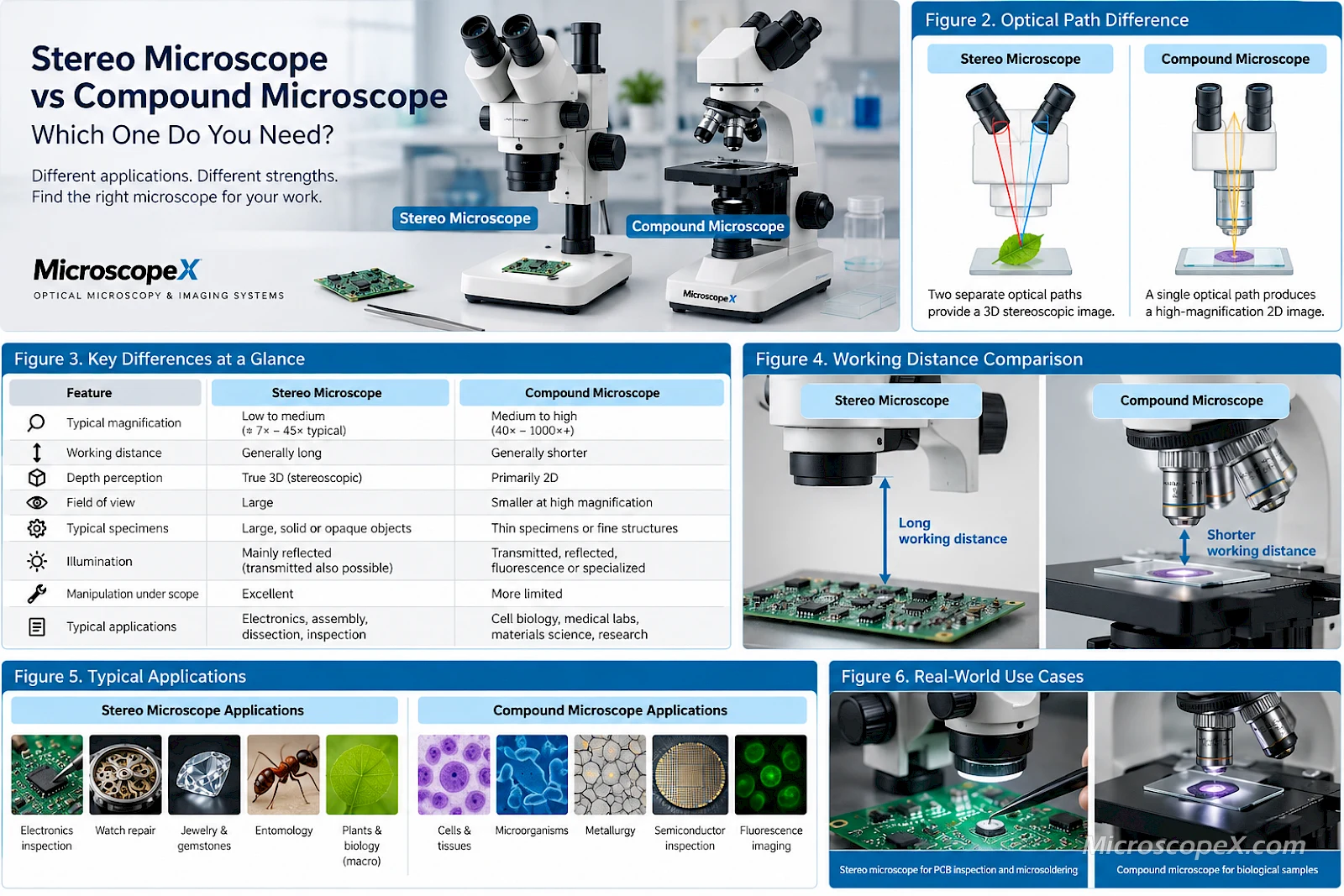
Unlike most conventional compound microscope systems, a stereo microscope uses two separate optical paths to present slightly different images to the left and right eyes.
Your brain combines these two views to create a strong sense of depth.
This makes the specimen appear three-dimensional and allows the operator to judge height, surface structure, component position, and tool placement more naturally.
Stereo microscopes are widely used for applications such as:
Electronics and PCB inspection
Microsoldering
Mechanical assembly
Quality control
Jewelry and gemstone inspection
Watch repair
Biological dissection
Entomology
Plant observation
Forensic examination
Education
Small-part manufacturing
One of the most important advantages of a stereo microscope is its long working distance.
There is usually significantly more space between the objective and the specimen than with a conventional high-power compound microscope. This provides room for tweezers, soldering irons, probes, scalpels, or other tools.
For applications that involve manipulating the specimen while viewing it, working distance can be just as important as magnification.
What Is a Compound Microscope?
A compound microscope is generally designed for higher-magnification observation of fine structures that cannot be adequately resolved with the naked eye or a low-power optical system.
It uses an objective lens close to the specimen to produce a magnified image, which is then further enlarged by the eyepiece or captured by a camera.
Typical compound microscope applications include:
Cell biology
Histology
Microbiology
Pathology
Medical laboratories
Laboratory education
Metallography
Semiconductor inspection
Materials science
Fluorescence microscopy
Polarized-light microscopy
Biological compound microscopes commonly examine specimens mounted on glass slides and illuminated from below.
However, the term compound microscope covers a much wider range of optical systems.
Depending on the application, compound microscopes may include:
Upright biological microscopes
Fluorescence microscopes
For this reason, compound microscopes should not be thought of simply as "school microscopes." Modern compound microscope systems range from basic educational instruments to advanced research and industrial imaging platforms.
Stereo Microscope vs Compound Microscope: Key Differences
The easiest way to understand the two systems is to compare their most important characteristics.
| Feature | Stereo Microscope | Compound Microscope |
|---|---|---|
| Typical purpose | Surface observation, inspection and manipulation | High-resolution observation of fine structures |
| Image perception | True stereoscopic depth perception | Primarily flat optical image |
| Typical magnification | Low to medium | Medium to high |
| Working distance | Generally long | Generally shorter |
| Field of view | Large | Smaller at high magnification |
| Depth of field | Relatively large | Shallower at high magnification |
| Typical specimens | Large, solid or opaque objects | Thin specimens or fine surface structures |
| Illumination | Mainly reflected; transmitted also possible | Transmitted, reflected, fluorescence or specialized illumination |
| Manipulation under microscope | Excellent | More limited |
| Typical applications | Electronics, assembly, dissection, inspection | Biology, medicine, materials science, research |
Let's examine these differences more closely.
1. Magnification
Magnification is often the first specification buyers consider, but it should not be the only one.
Stereo microscopes
Stereo microscopes are optimized for relatively low magnification.
A typical zoom stereo microscope may provide a continuous range such as approximately 7× to 45× in a standard configuration, while auxiliary objectives and different eyepieces can extend the usable range considerably.
Some high-resolution stereo systems can reach much higher magnifications.
However, the main purpose of a stereo microscope is not simply to achieve the highest possible magnification. It is to combine useful magnification with:
A wide field of view
Good depth perception
Long working distance
Convenient specimen manipulation
Compound microscopes
Compound microscopes are designed to achieve substantially higher optical magnification.
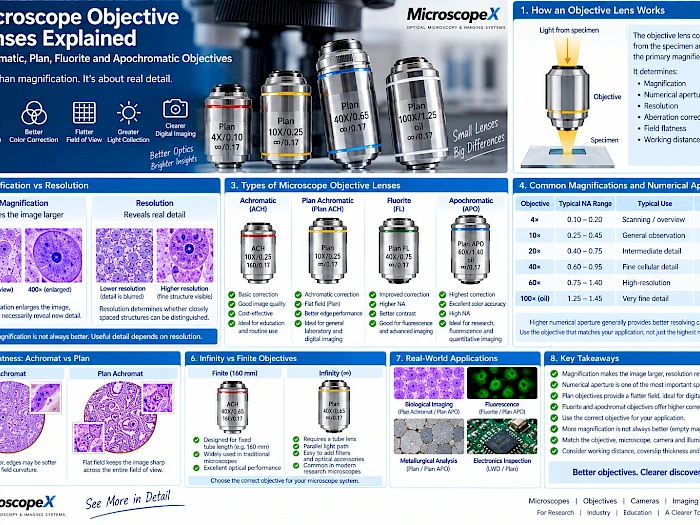
Biological microscopes commonly use objectives such as:
4×
10×
20×
40×
60×
100×
With a 10× eyepiece, these objectives can produce total magnifications ranging from 40× to 1000× or more.
But magnification alone does not determine how much detail you can see.
Optical resolution and numerical aperture are ultimately more important than simply increasing magnification.
2. Depth Perception
This is one of the most fundamental differences.
Stereo microscope: strong 3D perception
A stereo microscope provides separate optical views for each eye.
Because the two images are observed from slightly different angles, the operator perceives depth.
This is extremely useful when working with objects that have significant surface relief.
For example, when soldering a component onto a circuit board, the operator needs to understand not only the width and length of the component but also its height and position relative to surrounding components.
The stereoscopic image makes this much easier.
Compound microscope: optimized for fine detail
Most compound microscopes do not provide the same stereoscopic depth perception.
Even when a compound microscope has a binocular head, both eyes generally observe the same optical image rather than two significantly different viewing angles.
The advantage is that the optical system can instead be optimized for high-resolution observation of very small features.
3. Working Distance
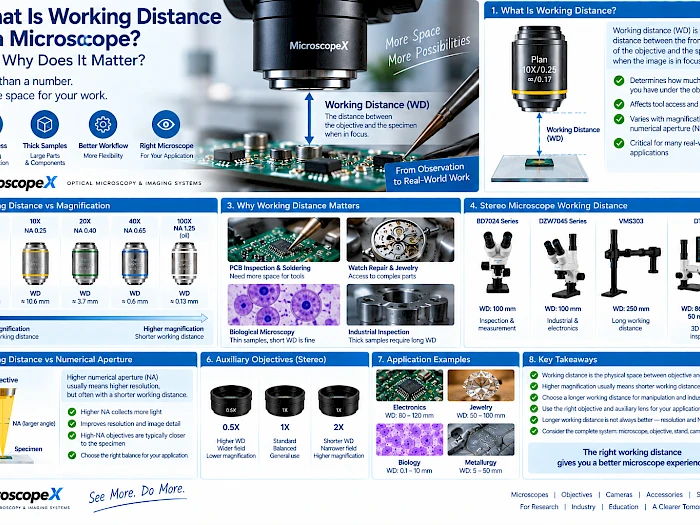
Working distance is the distance between the front of the objective and the specimen when the specimen is in focus.
This specification is extremely important in industrial and manipulation applications.
Stereo microscopes
Stereo microscopes normally provide much more space between the microscope and the specimen.
This makes it possible to use:
Soldering irons
Tweezers
Scalpels
Probes
Measurement tools
Assembly tools
without constantly colliding with the microscope objective.
Long working distance is one reason stereo microscopes are so popular for electronics repair and manufacturing inspection.
Compound microscopes
As objective magnification and numerical aperture increase, working distance generally becomes shorter.
High-magnification compound objectives may operate very close to the specimen.
This is not necessarily a disadvantage. It is part of the optical design required to achieve high resolution.
But it means compound microscopes are usually less convenient when large tools must be used directly around the specimen.
4. Field of View
The field of view is the area of the specimen visible through the microscope at one time.
Stereo microscopes typically provide a relatively wide field of view.
This makes them particularly useful when you need to:
Locate features quickly
Navigate around a large specimen
Observe an entire small component
Assemble parts
Follow tools while working
Compound microscopes provide a much smaller field of view as magnification increases.
This is appropriate when the goal is to inspect microscopic detail rather than the overall structure of a large object.
5. Depth of Field
Depth of field describes how much of the specimen remains acceptably in focus at different heights.
Stereo microscopes generally offer relatively generous depth of field, particularly at lower magnifications.
This helps when observing irregular three-dimensional objects.
Compound microscopes operating at high numerical aperture typically have much shallower depth of field.
At high magnification, only a very thin region of the specimen may be sharply focused.
For biological research and high-resolution imaging, this shallow optical section can actually be useful because it allows fine structures at different depths to be examined individually.
What Type of Specimen Are You Observing?
A very practical way to choose a microscope is to start with the specimen.
Choose a Stereo Microscope for Larger, Solid Objects
Stereo microscopes are particularly suitable for objects such as:
Printed circuit boards
Electronic components
Mechanical parts
Insects
Flowers and leaves
Rocks and minerals
Gemstones
Coins
Watches
Jewelry
Small manufactured components
These specimens normally do not need to be prepared as thin sections.
You can simply place the object beneath the microscope and begin observing it.
Choose a Compound Microscope for Fine Microscopic Detail
Compound microscopes are more appropriate when examining:
Cells
Bacteria
Tissue sections
Blood smears
Microorganisms
Thin biological specimens
Metallographic samples
Semiconductor structures
Material surfaces
Fluorescently labeled specimens
Depending on the microscopy technique, specimens may require slide preparation, staining, polishing, fluorescence labeling, or other preparation methods.
Reflected Light vs Transmitted Light
Another important difference is how the specimen is illuminated.
Reflected Illumination
For opaque objects, light cannot pass through the specimen.
Instead, light must illuminate the surface from above and reflect back into the microscope.
This is common in stereo microscopy.
Examples include:
Circuit boards
Metal components
Jewelry
Stones
Mechanical parts
LED ring lights are widely used with stereo microscopes because they provide bright and relatively uniform illumination.
More specialized systems may use directional, coaxial, polarized, or other illumination techniques depending on the application.
Transmitted Illumination
Many biological compound microscopes illuminate the specimen from below.
Light passes through the specimen and enters the objective.
This works well for thin or transparent samples such as cells and tissue sections.
The condenser and aperture diaphragm help control how the illumination reaches the specimen and are important components of the optical system.
Not all compound microscopes use transmitted light.
Metallurgical microscopes, for example, commonly use reflected illumination because polished metal, semiconductor wafers, and many industrial samples are opaque.
Which Microscope Is Better for Electronics and PCB Inspection?
For most electronics work, a stereo microscope is the preferred choice.
Electronics inspection requires a combination of:
Moderate magnification
Large working distance
Wide field of view
Depth perception
Comfortable viewing
Space for tools
These characteristics are especially important for:
PCB inspection
Microsoldering
Smartphone repair
Connector repair
Component placement
Failure analysis
Manufacturing quality control
A zoom stereo microscope can be particularly convenient because the operator can move continuously between a wider overview and a more detailed view without changing objectives.
A trinocular stereo microscope can also accommodate a microscope camera for documentation, training, measurement, or live display.
Which Microscope Is Better for Biology?
For most cellular and microbiological applications, a compound biological microscope is the correct choice.
The structures being examined are usually too small for conventional stereo microscopy.
A biological compound microscope provides the higher magnification and numerical aperture required to resolve features such as:
Cells
Cell nuclei
Tissue structures
Microorganisms
Blood cells
Other microscopic biological structures
Depending on the research application, more advanced techniques may be required, including:
Phase contrast
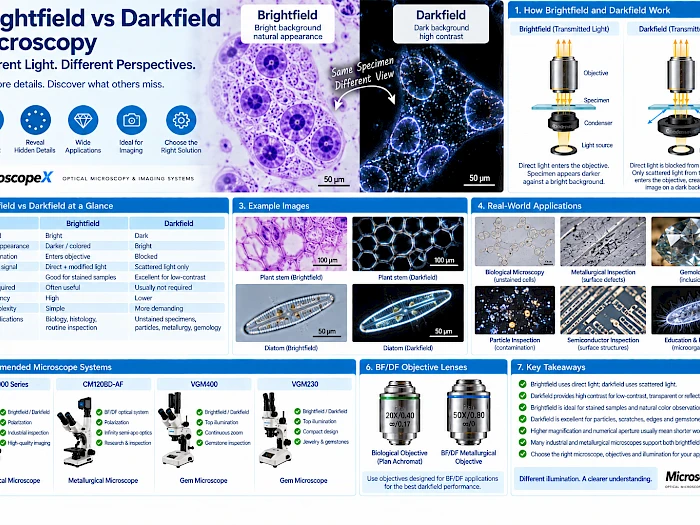
Darkfield
Fluorescence
Polarized light
Differential interference contrast
Inverted microscopy
What About Materials Science and Industrial Inspection?
This is one area where the answer is not always simply "stereo" or "compound."
Both types may be useful.
A stereo microscope is excellent for:
Initial visual inspection
Surface defects
Component examination
Fracture observation
Assembly
Larger samples
A metallurgical compound microscope may then be used when higher-resolution examination is required.
Applications can include:
Metal microstructure analysis
Coatings
Semiconductor wafers
Polymers
Surface defects
Grain structures
Material interfaces
In professional laboratories, stereo and compound microscopes therefore often complement each other rather than compete with each other.
Binocular or Trinocular?
Once you have selected the microscope type, another decision is whether you need a binocular or trinocular configuration.
A binocular microscope is designed primarily for direct observation through two eyepieces.
A trinocular microscope adds a third optical port that can be connected to a microscope camera.
A trinocular system is particularly useful when you need to:
Capture images
Record video
Display the image on a monitor
Document inspections
Perform measurements
Share observations with students or colleagues
Use image-analysis software
If digital imaging is an important part of your workflow, a trinocular configuration is usually worth considering.
Can You Add a Camera to Both Types of Microscope?
Yes.
Both stereo and compound microscopes can be integrated with digital imaging systems.
A typical setup may include:
Microscope
Trinocular imaging port
Computer or monitor
Imaging or measurement software
However, the correct camera and adapter depend on the microscope optical system and the intended application.
Important considerations include:
Camera sensor size
Resolution
Pixel size
Frame rate
C-mount adapter magnification
Field of view
HDMI or USB output
Measurement requirements
Low-light performance
The microscope and camera should therefore be selected as a complete imaging system rather than as unrelated components whenever possible.
Stereo Microscope or Compound Microscope? A Simple Decision Guide
Use the following questions to narrow down your choice.
Do you need to inspect a circuit board, mechanical part, insect, jewelry item, or other relatively large object?
Choose a stereo microscope.
Do you need to see cells, tissue structures, microorganisms, or other microscopic detail?
Choose a compound microscope.
Do you need room to work with tools underneath the microscope?
Choose a stereo microscope.
Do you need high numerical aperture and high optical resolution?
Choose a compound microscope.
Do you need strong depth perception?
Choose a stereo microscope.
Are you performing microsoldering or assembly?
Choose a stereo microscope.
Are you performing biological laboratory work?
In most cases, choose a compound microscope.
Are you inspecting materials or semiconductor samples?
The answer depends on the scale of the features.
Use a stereo microscope for overview inspection and manipulation, and a metallurgical or other compound microscope when higher-resolution analysis is required.
Frequently Asked Questions
Is a stereo microscope the same as a dissecting microscope?
In most contexts, yes.
"Stereo microscope," "stereoscopic microscope," and "dissecting microscope" commonly refer to the same general class of low-magnification microscope designed to provide depth perception and a relatively long working distance.
Can a stereo microscope see cells?
Some relatively large biological structures may be visible under a stereo microscope, but conventional stereo microscopes are not normally the best choice for examining individual cells in detail.
For cellular observation, a compound biological microscope is generally more appropriate.
Is higher magnification always better?
No.
Increasing magnification without increasing optical resolution simply produces a larger image without revealing additional useful detail.
The correct microscope should provide the necessary combination of magnification, resolution, field of view, working distance, and illumination for the application.
Why do electronics technicians use stereo microscopes?
Stereo microscopes provide a combination of three-dimensional perception, long working distance, wide field of view, and moderate magnification.
This makes it easier to position components and manipulate soldering tools while observing the work.
Can a compound microscope inspect opaque objects?
Yes, provided the microscope is designed with an appropriate reflected-light system.
Metallurgical microscopes are a common example. They illuminate opaque specimens from above through the objective rather than relying exclusively on transmitted light from below.
Which microscope should I buy for general laboratory use?
There is no single microscope suitable for every laboratory application.
A biological laboratory primarily studying cells may require a compound microscope, while an electronics laboratory may rely on stereo microscopes.
Materials laboratories may use both stereo microscopes and metallurgical compound microscopes at different stages of inspection.
The best approach is to define the specimen size, required resolution, illumination method, working distance, and imaging requirements before selecting the instrument.
Conclusion
Stereo and compound microscopes are designed to solve different observation problems.
Choose a stereo microscope when you need:
A three-dimensional view
A large field of view
Long working distance
Surface observation
Specimen manipulation
Electronics inspection
Assembly or dissection
Choose a compound microscope when you need:
Higher magnification
Higher optical resolution
Cellular or microscopic detail
Biological microscopy
Metallurgical analysis
Fluorescence or other advanced microscopy techniques
In many professional laboratories, the two systems are complementary.
A stereo microscope can provide an overview of a specimen and allow physical manipulation, while a compound microscope can reveal much finer structures at higher resolution.
The most effective microscope is therefore not necessarily the one with the highest magnification. It is the one whose optics, working distance, illumination, imaging system, and mechanical configuration match your application.
Find the Right Microscope for Your Application
MicroscopeX provides optical microscopy and imaging systems for biological imaging, materials analysis, laboratory research, and industrial inspection.
Explore:
Stereo Microscopes
For industrial inspection, electronics, manipulation, dissection, education, and general low-power observation.
Compound Microscopes
For biological imaging, materials analysis, metallurgical inspection, fluorescence microscopy, and high-resolution laboratory applications.
Need help configuring a complete microscope and camera system?
Contact MicroscopeX for application and product selection support.