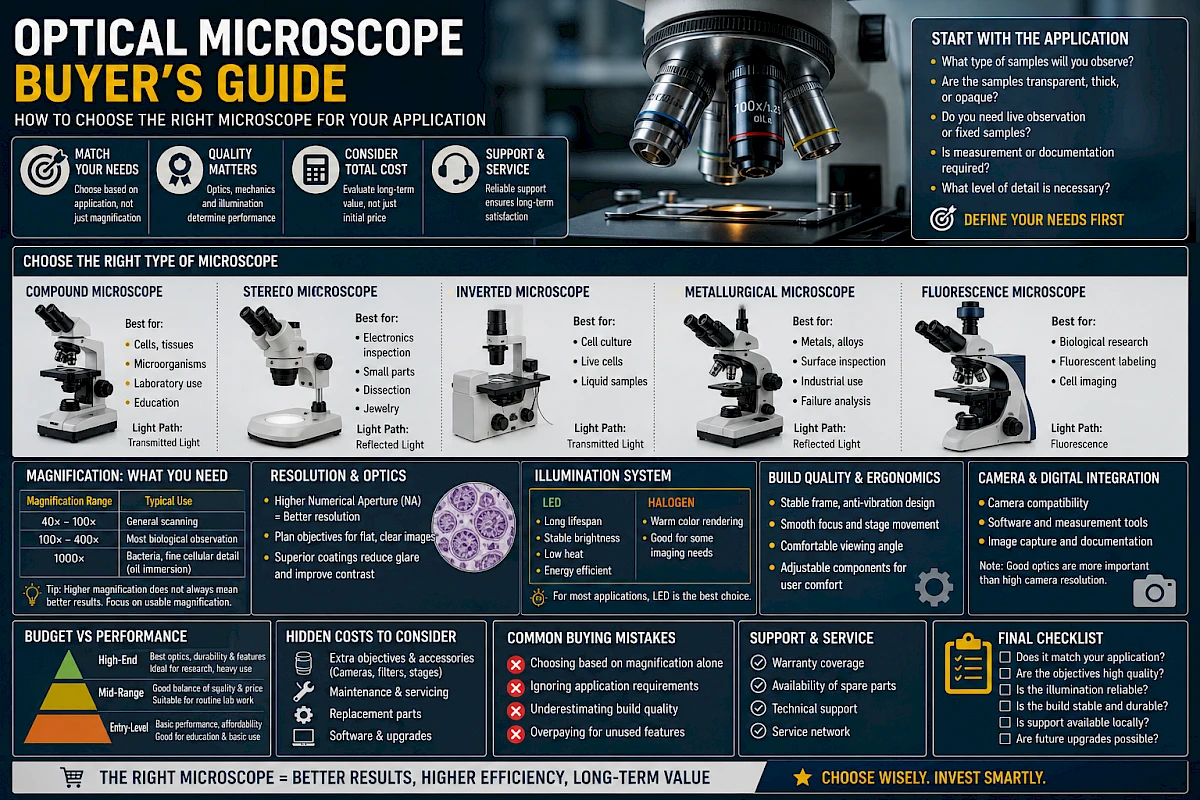
Optical Microscope Buyer’s Guide: How to Choose the Right Microscope for Your Application
Choosing the right optical microscope is not about selecting the highest magnification or the most expensive model. It is about matching the instrument to your specific application, workflow, and long-term requirements.
This guide provides a structured approach to help you select the right microscope with confidence.
1. Start with the Application, Not the Specifications
Before comparing models, clearly define how the microscope will be used.
Key Questions to Ask
- What type of samples will you observe?
- Are the samples transparent, thick, or opaque?
- Do you need live observation or fixed samples?
- Is measurement or documentation required?
- What level of detail is necessary?
Your answers will determine the type of microscope you need.
2. Choosing the Right Type of Microscope
Compound Microscope
Best for:
- Cells and tissues
- Microorganisms
- Laboratory and clinical use
- Educational environments
Not ideal for:
- Large or solid objects
- Surface inspection
Stereo Microscope (Dissecting Microscope)
Best for:
- Electronics inspection
- Small mechanical parts
- Biological dissection
- Jewelry and craftsmanship
Advantages:
- 3D visualization
- Long working distance
- Easy manipulation of samples
Inverted Microscope
Best for:
- Cell culture
- Liquid samples
- Live cell observation
Key advantage:
- Allows observation through the bottom of culture vessels
Metallurgical Microscope
Best for:
- Metals and alloys
- Surface coatings
- Industrial inspection
- Failure analysis
Uses reflected light instead of transmitted light.
Fluorescence Microscope
Best for:
- Advanced biological research
- Protein labeling
- Cell imaging
Requires:
- Fluorescent dyes or markers
- Specialized filters and light sources
3. Magnification: What You Actually Need
A common mistake is overestimating magnification needs.
Typical Use Cases
- 40×–100×: general scanning
- 100×–400×: most biological observation
- 1000×: bacteria, fine cellular detail (with oil immersion)
Higher magnification does not guarantee better results.
Focus on usable magnification, not maximum magnification.
4. Resolution Matters More Than Magnification
Resolution determines how much detail you can actually see.
Key factors affecting resolution:
- Objective lens quality
- Numerical aperture (NA)
- Illumination system
- Optical alignment
A well-designed 400× system often performs better than a poorly configured 1000× system.
5. Objective Lenses: The Most Critical Component
When evaluating a microscope, pay close attention to the objectives.
What to Look For
- Plan objectives (flat field across the image)
- Achromatic or better optical correction
- High numerical aperture
- Proper coatings
Higher-quality objectives significantly improve image clarity and consistency.
6. Illumination System
LED vs Halogen
LED Advantages:
- Long lifespan
- Stable brightness
- Low heat
- Energy efficient
Halogen Advantages:
- Warmer color rendering
- Preferred in some imaging applications
For most users, LED is the better choice.
7. Mechanical Stability and Build Quality
A microscope is not just optics—it is also a mechanical system.
Key Elements
- Smooth and precise focus mechanism
- Stable stage movement
- Rigid frame (reduces vibration)
- Reliable nosepiece alignment
Poor mechanical quality leads to:
- Focus drift
- Image instability
- User fatigue
8. Ergonomics and User Comfort
For frequent use, ergonomics is critical.
Consider:
- Adjustable eyepiece height
- Comfortable viewing angle
- Smooth controls
- Low effort focusing
Poor ergonomics can reduce productivity and cause strain during long sessions.
9. Camera and Digital Integration
If documentation is required:
Check for:
- Camera compatibility
- Software support
- Image capture options
- Measurement tools
Important Consideration
Do not prioritize camera resolution over optical quality.
A high-resolution camera cannot fix poor optics.
10. Budget vs Performance
Entry-Level
- Suitable for education and basic observation
- Limited durability and optical performance
Mid-Range
- Good balance of quality and price
- Suitable for routine lab work
High-End
- Superior optics and mechanics
- Designed for research and heavy use
- Higher cost but better long-term value
11. Hidden Costs to Consider
The purchase price is not the only cost.
Additional Expenses
- Extra objectives
- Camera systems
- Maintenance and servicing
- Replacement parts
- Accessories (filters, stages, illumination upgrades)
Plan for total cost of ownership, not just initial price.
12. Brand and Support
Reliable support is often overlooked.
Look for:
- Warranty coverage
- Availability of spare parts
- Technical support
- Service network
A slightly more expensive microscope with strong support may be a better investment.
13. Common Buying Mistakes
Choosing Based on Magnification Alone
This leads to poor real-world performance.
Ignoring Application Requirements
Using the wrong type of microscope limits usability.
Underestimating Build Quality
Cheap construction leads to frequent issues.
Overpaying for Unused Features
Advanced features are only valuable if actually needed.
14. Quick Selection Guide
For Education
- Compound microscope
- 4×, 10×, 40× objectives
- LED illumination
For Laboratory Work
- Compound microscope
- 4×, 10×, 40×, 100× objectives
- Good-quality optics
- Optional camera
For Industrial Inspection
- Stereo microscope or metallurgical microscope
- Stable stand
- Adjustable lighting
For Cell Culture
- Inverted microscope
- Long working distance
- Phase contrast (optional)
15. Final Checklist Before Buying
- Does it match your application?
- Are the objectives high quality?
- Is the illumination system reliable?
- Is the build stable and durable?
- Is support available locally?
- Are future upgrades possible?
If all answers are yes, the microscope is likely a good fit.
Conclusion
Selecting the right microscope is a balance between application needs, optical performance, mechanical quality, and long-term usability.
Instead of focusing on specifications alone, evaluate how the microscope will perform in your actual workflow.
A well-chosen microscope improves efficiency, accuracy, and overall user experience—making it a valuable long-term investment.