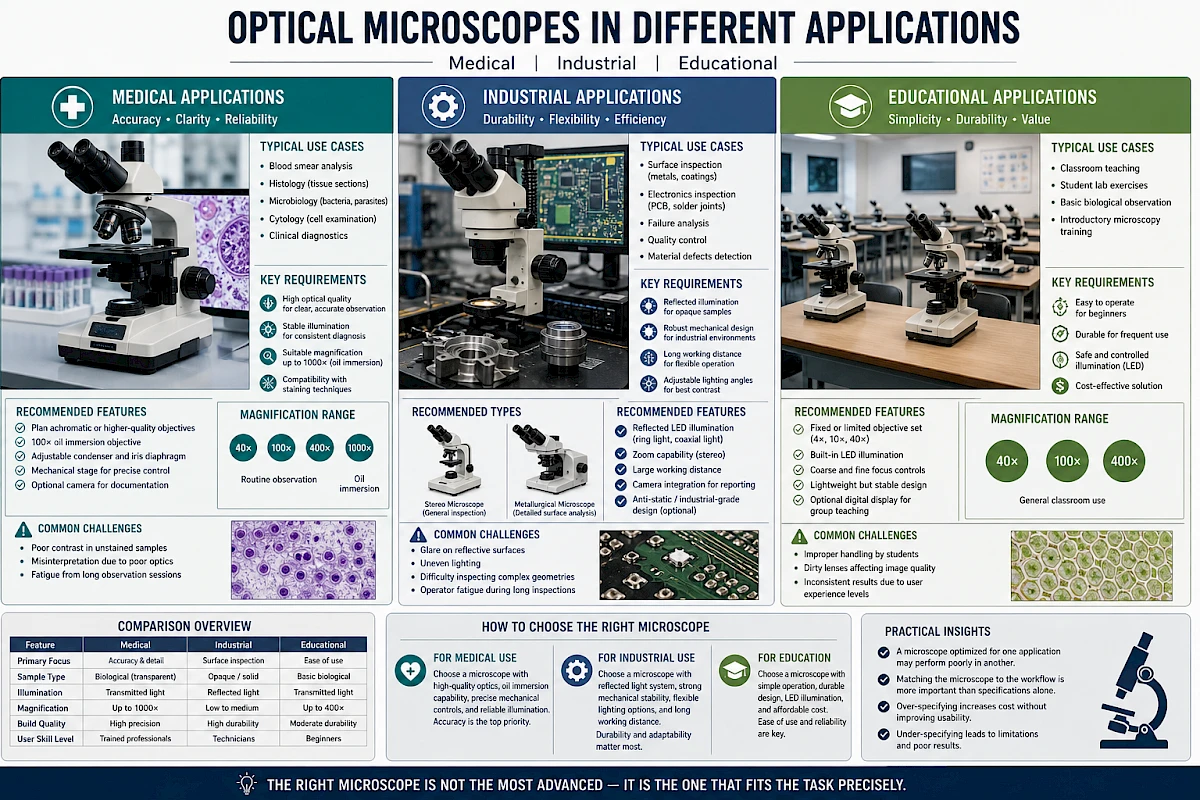
Optical Microscopes in Different Applications: Medical, Industrial, and Educational Use Cases
Optical microscopes are used across a wide range of industries, but the requirements vary significantly depending on the application. A microscope that performs well in a classroom may not be suitable for industrial inspection, and a clinical microscope has very different priorities compared to a teaching instrument.
This guide breaks down how microscopes are used in three major fields—medical, industrial, and educational—and what features matter most in each scenario.
1. Medical Applications
Typical Use Cases
- Blood smear analysis
- Histology (tissue sections)
- Microbiology (bacteria, parasites)
- Cytology (cell examination)
- Clinical diagnostics
Medical microscopy focuses on accuracy, consistency, and detail recognition.
Key Requirements
High Optical Quality
- Clear resolution of fine cellular structures
- Accurate color reproduction (important for staining)
- Minimal optical distortion
Reliable Illumination
- Stable brightness for consistent diagnosis
- Even illumination across the field
- Adjustable contrast for different staining methods
Magnification Range
- 40×–400×: routine observation
- 1000× (oil immersion): bacteria and fine cellular detail
Compatibility with Staining Techniques
Common stains include:
- Hematoxylin and eosin (H&E)
- Gram staining
- Wright-Giemsa staining
The microscope must render these clearly and consistently.
Recommended Features
- Plan achromatic or higher-quality objectives
- 100× oil immersion objective
- Adjustable condenser and diaphragm
- Mechanical stage for precise slide control
- Optional camera for documentation
Common Challenges
- Poor contrast in unstained samples
- Misinterpretation due to poor optics
- Fatigue from long observation sessions
2. Industrial Applications
Typical Use Cases
- Surface inspection (metals, coatings)
- Electronics inspection (PCB, solder joints)
- Failure analysis
- Quality control
- Material defects detection
Industrial microscopy focuses on surface detail, durability, and flexibility.
Key Requirements
Reflected Light Capability
Most industrial samples are opaque, so:
- Reflected illumination is essential
- Adjustable lighting angles improve visibility
Robust Mechanical Design
- Stable frame to reduce vibration
- Durable components for frequent use
- Resistance to dust and environmental conditions
Flexible Magnification
- Low magnification for overview
- Moderate magnification for detail inspection
Long Working Distance
Important for:
- Handling tools
- Manipulating samples
- Inspecting larger objects
Recommended Microscope Types
- Stereo microscope (for general inspection)
- Metallurgical microscope (for detailed surface analysis)
Recommended Features
- Adjustable LED lighting (ring light, coaxial light)
- Large working distance
- Zoom capability (in stereo microscopes)
- Camera integration for reporting
- Anti-static or industrial-grade design (if needed)
Common Challenges
- Glare on reflective surfaces
- Uneven lighting
- Difficulty inspecting complex geometries
- Operator fatigue during long inspections
3. Educational Applications
Typical Use Cases
- Classroom teaching
- Student lab exercises
- Basic biological observation
- Introductory microscopy training
Education-focused microscopes prioritize ease of use, durability, and cost efficiency.
Key Requirements
Simplicity and Reliability
- Easy to operate for beginners
- Minimal setup complexity
- Consistent performance across units
Durability
- Resistant to frequent handling
- Stable construction
- Low maintenance requirements
Safe and Controlled Illumination
- LED lighting preferred
- Low heat output
- Energy efficient
Appropriate Magnification Range
- 40×–400× is sufficient for most teaching purposes
Recommended Features
- Fixed or limited objective set (4×, 10×, 40×)
- Built-in LED illumination
- Coarse and fine focus controls
- Lightweight but stable design
- Optional digital display for group teaching
Common Challenges
- Improper handling by students
- Dirty lenses affecting image quality
- Inconsistent results due to user experience levels
4. Comparing the Three Applications
| Feature | Medical | Industrial | Educational |
|---|---|---|---|
| Primary Focus | Accuracy & detail | Surface inspection | Ease of use |
| Sample Type | Biological (transparent) | Opaque / solid | Basic biological |
| Illumination | Transmitted light | Reflected light | Transmitted light |
| Magnification | Up to 1000× | Low to medium | Up to 400× |
| Build Quality | High precision | High durability | Moderate durability |
| User Skill Level | Trained professionals | Technicians | Beginners |
5. Choosing the Right Microscope for Your Scenario
For Medical Use
Choose a microscope with:
- High-quality optics
- Oil immersion capability
- Precise mechanical controls
- Reliable illumination
Accuracy is the top priority.
For Industrial Use
Choose a microscope with:
- Reflected light system
- Strong mechanical stability
- Flexible lighting options
- Long working distance
Durability and adaptability matter most.
For Education
Choose a microscope with:
- Simple operation
- Durable design
- LED illumination
- Affordable cost
Ease of use and reliability are key.
6. Practical Insights
- A microscope optimized for one application may perform poorly in another
- Over-specifying features increases cost without improving usability
- Under-specifying leads to limitations and poor results
- Matching the microscope to the workflow is more important than specifications alone
Conclusion
Different applications demand different microscope capabilities. Understanding the specific requirements of medical, industrial, and educational use cases helps avoid costly mistakes and ensures better performance.
The right microscope is not the most advanced—it is the one that fits the task precisely.