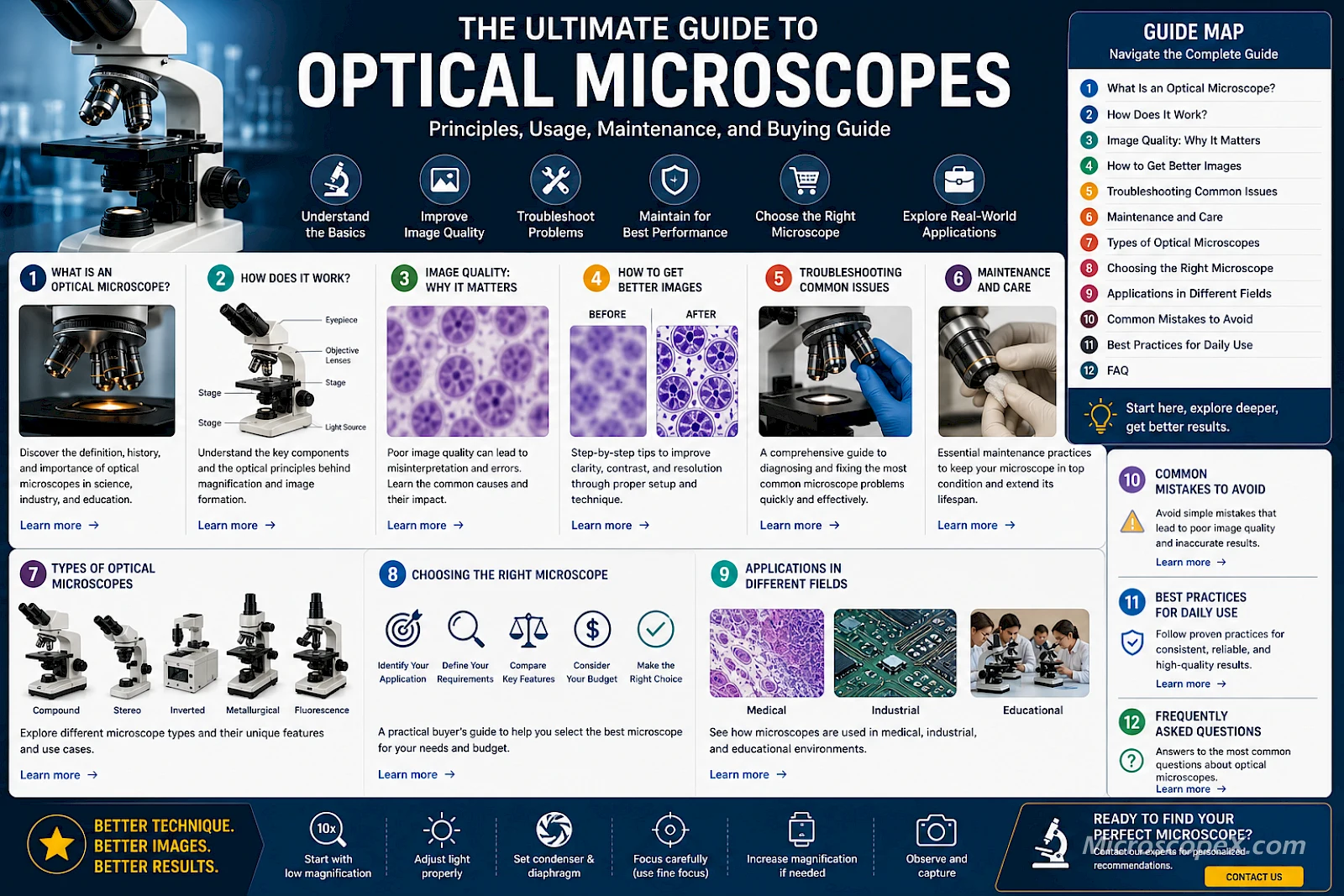
Ultimate Guide to Optical Microscopes: Principles, Usage, Maintenance, and Buying Guide
Optical microscopes are essential tools in laboratories, medical diagnostics, industrial inspection, and education. Despite their widespread use, many users struggle with image quality, proper setup, and selecting the right system for their needs.
This guide brings together everything you need to understand, use, maintain, and choose an optical microscope—whether you are a beginner or a professional.
What Is an Optical Microscope?
An optical microscope uses visible light and precision lenses to magnify small objects so they can be observed in detail.
It is widely used for:
- Biological analysis (cells, tissues, bacteria)
- Clinical diagnostics
- Industrial inspection
- Educational training
- Research applications
For a complete introduction, see:
Optical Microscope Basics
How Does an Optical Microscope Work?
The microscope works by directing light through or onto a sample and magnifying the resulting image through a system of lenses.
Key components include:
- Objective lenses (primary magnification)
- Eyepiece (secondary magnification)
- Condenser (focuses light)
- Iris diaphragm (controls contrast)
- Illumination system (light source)
Understanding how these components interact is essential for achieving clear images.
Learn more:
Optical Microscope Basics
Why Image Quality Matters
A microscope is only as useful as the image it produces.
Poor image quality leads to:
- Misinterpretation of results
- Reduced accuracy in analysis
- Wasted time during observation
Common problems include:
- Blurry images
- Low contrast
- Uneven illumination
- Glare or artifacts
Read more:
10 Reasons Why Your Microscope Images Look Bad (And How to Fix Them)
How to Improve Microscope Image Quality
Improving image quality does not require expensive equipment. Most improvements come from proper setup and technique.
Key factors include:
- Correct illumination
- Proper condenser adjustment
- Optimized diaphragm setting
- Clean optical components
- Accurate focusing technique
Step-by-step guide:
How to Get Better Images with an Optical Microscope
Microscope Troubleshooting
When something goes wrong, a structured approach helps identify the issue quickly.
Most problems are caused by:
- Dirt or contamination
- Incorrect alignment
- Improper lighting
- User technique
Full troubleshooting guide:
Microscope Troubleshooting Guide
Microscope Maintenance and Care
Regular maintenance ensures consistent performance and extends the lifespan of your microscope.
Essential practices include:
- Cleaning lenses properly
- Removing immersion oil immediately
- Protecting against dust and humidity
- Handling the microscope carefully
Detailed maintenance guide:
Optical Microscope Maintenance Guide
Types of Optical Microscopes
Different applications require different microscope types.
Common Types
- Compound microscopes (biological observation)
- Stereo microscopes (3D inspection)
- Inverted microscopes (cell culture)
- Metallurgical microscopes (industrial materials)
- Fluorescence microscopes (advanced research)
See how they compare:
Optical Microscopes in Different Applications
Choosing the Right Microscope
Selecting the right microscope depends on your application—not just specifications.
Key factors to consider:
- Sample type (transparent vs opaque)
- Required magnification
- Resolution and optical quality
- Illumination system
- Mechanical stability
- Budget and long-term value
Complete selection guide:
Optical Microscope Buyer’s Guide
Applications of Optical Microscopes
Microscopes are used across multiple industries, each with unique requirements.
Medical
- Diagnostic accuracy
- High-resolution imaging
- Consistent illumination
Industrial
- Surface inspection
- Durability and stability
- Flexible lighting
Educational
- Ease of use
- Cost efficiency
- Basic functionality
Learn more:
Optical Microscopes in Different Applications
Common Mistakes to Avoid
Many users experience poor results due to simple mistakes:
- Using too much magnification
- Ignoring illumination settings
- Not cleaning lenses properly
- Incorrect focusing technique
- Poor sample preparation
Avoiding these mistakes can dramatically improve results.
Best Practices for Daily Use
To ensure optimal performance:
- Start with low magnification
- Adjust light before focusing
- Use fine focus for precision
- Keep lenses clean
- Store the microscope properly
Consistency in technique leads to consistent results.
Frequently Asked Questions
What magnification do I need?
Most applications are covered within 40×–400×.
1000× is used mainly for bacteria and fine detail.
Why is my image blurry?
Common causes include dirty lenses, incorrect focus, or improper illumination.
See:
Microscope Troubleshooting Guide
Do I need oil immersion?
Only for 100× objectives designed for oil use. It improves resolution for very fine detail.
How often should I clean my microscope?
Clean lenses only when needed, but always remove immersion oil immediately after use.
Conclusion
An optical microscope is a powerful tool, but its performance depends on how it is used and maintained.
By understanding the fundamentals, applying proper techniques, and following a structured approach, you can achieve clear, reliable, and high-quality results.
Related Guides
- Optical Microscope Basics
- How to Get Better Images with an Optical Microscope
- Microscope Troubleshooting Guide - Optical Microscope Maintenance Guide
- Optical Microscope Buyer’s Guide
- Optical Microscopes in Different Applications
Need Help Choosing the Right Microscope?
If you are selecting a microscope for your lab, classroom, or industrial application, choosing the right configuration can save time and cost.
Contact our team for expert recommendations tailored to your needs.